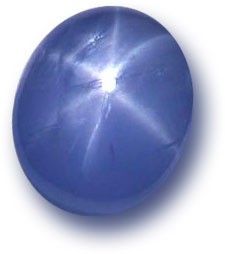
A sapphire means blue in Greek. The blue goes from dark blue almost black to pale blue. The finest blue sapphires are a strong blue. The star sapphire is very valued. Sapphires of colors other than blue are always referred to with the color. There are pink sapphires, yellow sapphires, violet sapphires, green sapphires and clear sapphires. Today most sapphires are mined in Australia.
The sapphire was called the "Stone of Destiny". Sapphires contribute to mental clarity and perception. They can promote financial rewards.
The sapphire is the symbol of heaven and joyful devotion to God.
Sapphire is associated with Aquarius, Virgo, Libra and Capricorn. It is the birthstone of September and has been the birthstone of April. Sapphire is the symbol of Saturn (dark blue) and Venus (light blue). [5]
Varieties/Types:
- Padparadscha - A salmon-pink coloured Sapphire.
- Star Sapphire - A chatoyant sapphire showing asterism.
Sapphire Treatments
Star-diffusion(titanium): Surface-diffusion on a gem already cut into cabochon shape: strong star effect occuring at and just below the surface. Fiber-optic light: shallow fuzzy whitish surface layer. Very fine "silk", thin fabric structure. In most cases, unlike natural, the rays do not show a 90° orientation to color zoning (crystal faces).
Diffusion (beryllium): Most corundum with orangy hue, strong bi-coloration and saturated colours, typically yellow, orange, red-orangy, orangy-pink, pink-purple, hot pink, and padparadscha colour are beryllium treated. Other colours may also result or be improved by this treatment (typically ruby, blue and green sapphires): standard tests are limited especially for clean light gems. Very high heat treatment is required to diffuse the colouring agent into the gem. Resulting inclusions are distorted melted guest crystals such as white formless zircon (often with gas bubble). Most melted crystals are surrounded by discoid fractures often with dendritic pattern (partial recrystallization); they often show a cottony appearence. Dot-like inclusions are common. Colour concentration may be seen arround melted guest crystal. Colour zone following the shape of the gem (rim with distinct coloration from core): immersion in methylen iodide (or coconut/baby oil), diffused transmitted light, frosted complementary colour filters (blue for yellow-orangy).
YELLOW - Heat-treated: darken temporarily if heated (spoon and lighter 2 min or 15 min within 1 cm of 150W spot light). Yellow-orangy once produced by irradiation: colour fading permanently if heated.
Diffusion: colourless to yellow-orangy rim, blue haloes/spots (internal diffusion). Synthetic overgrowth can often be seen at girdle and culet: roiled appearance in transmitted light, light areas between cross-polarizing filters.
BLUE – Heat-treated: dot-like partially dissolved “silk”, rounded melted crystals surrounded by discoid fractures, diffused colour banding, blue spots.
GRAYISH-BLUE and WHITISH to WHITE, semitransparent sapphires with silky lustre due to rutile microinclusions, called "geuda" in Sri Lanka, become transparent and acquire a beautiful, bright blue colour after calcination at temperatures of 1600°C and higher. This is caused by the resorption of rutile and transfer of Ti4+ ion into the crystal lattice of corundum. This Ti4+, in combination with Fe2+, produces a colour centre. The intensity of the acquired colour is related to the ratio of iron and titanium admixtures in the initial raw material. Increased iron content results in an excessively dark colour (Harder, 1992).
Some COLOURLESS and PALE YELLOW iron-bearing sapphires (Sri Lanka and others) become bright yellow after annealing in oxidizing conditions due to an increase in the number of chromophore centres Fe3+ and Fe3++Fe3+.
Surface diffusion: looking table down with diffused transmitted light (immersion): colour concentration at facet junctions, in cracks, around girdle (cabs), uneven facet to facet colour distribution. May show natural colour zoning.
THERMAL DIFFUSION method is more universal and is suitable for treatment of pale-coloured sapphires, which are depleted in iron or do not contain oriented inclusions. In these cases the cut sapphires are exposed to a long (one day and more) exposure to temperatures of 1800 to 1900°C in a powder of titanium and iron oxides. Chromium oxide is used to produce pink and red colours, strontium for orange, cobalt for bright blue, etc. The diffusion of chromophore elements produces colour in a thin superficial layer of sapphire to a depth of tenths of a millimeter (Hanni, 1982).
In the 1980s the world market was saturated with annealed light blue and blue sapphires, which caused problems in distinguishing them from rare and more expensive stones with natural colour. "Fire marks", the discoid cracks of internal tension, are easily observed at medium magnification; the complete disappearance of CO2 inclusions; melted surfaces of large solid inclusions; the occurence of a network of small, thin channels; the sharp contrast between coloured and almost colourless zones; the decrease of dichroism, etc. are evidence of thermal processing. - E.Ya.Kievlenko, Geology of gems, 2003, p. 41 [37]